For years I snored. Not lightly, on average two to three hours a night, sometimes
three and a half. I never heard it. I was away in Lala land while my girlfriend lay awake,
waiting for it to start, which it always did within a few minutes of my head hitting the
pillow.
What I did notice was the aftermath. I’d wake up with a bone-dry mouth. I was tired in a
way that sleep didn’t seem to fix. And there was a low, constant brain fog I couldn’t
name, because I had nothing to compare it to. I didn’t realise what it was until it lifted.
The first time I woke up with a genuinely clear mind, easy to get out of bed, no reaching
for coffee to drag myself into the day, I understood what I’d been missing for years.
This is the story of how I fixed it, what worked, what didn’t, and the thing almost
nobody talks about that actually made the difference: tongue exercises.
Why Mouth Breathing Wrecks Your Sleep
When you breathe through your mouth all night, you bypass the one organ evolved
specifically for the job. Your nose filters, humidifies and pressurises every breath, and
it does something else most people have never heard of.
The paranasal sinuses, the air-filled cavities in your skull, produce nitric oxide. When
you breathe through your nose, that nitric oxide travels down into your lungs with each
breath. It’s a vasodilator, meaning it opens the blood vessels, and it improves the
uptake of oxygen into the blood by matching airflow to blood flow in the lungs. Breathe
through your mouth and you lose all of it. (Source: Lundberg, The Anatomical Record,
2008)
Nasal breathing also makes you use your diaphragm properly. The diaphragm has to
work to create the pressure change that draws air deep into the lungs, which gives you
slower, fuller breaths and helps settle the nervous system into its calm, parasympathetic
state. Mouth breathing keeps everything shallow and high in the chest — exactly the
pattern your body runs when it’s stressed. (This is the same nervous-system
mechanism I go into on the nervous system regulation page.)
If you want the full picture on why mouth breathing costs you so much, I’ve written about it
separately: is mouth breathing bad?
Mouth Taping: What Worked, and Why I Gave Up On It
I first heard about mouth taping during a course with Breathwork Africa, and around the
same time I started tracking my sleep with an app so I had actual data, not just my
girlfriend’s complaints.
I taped up, went to bed, peeled it off in the morning, that was the whole routine.
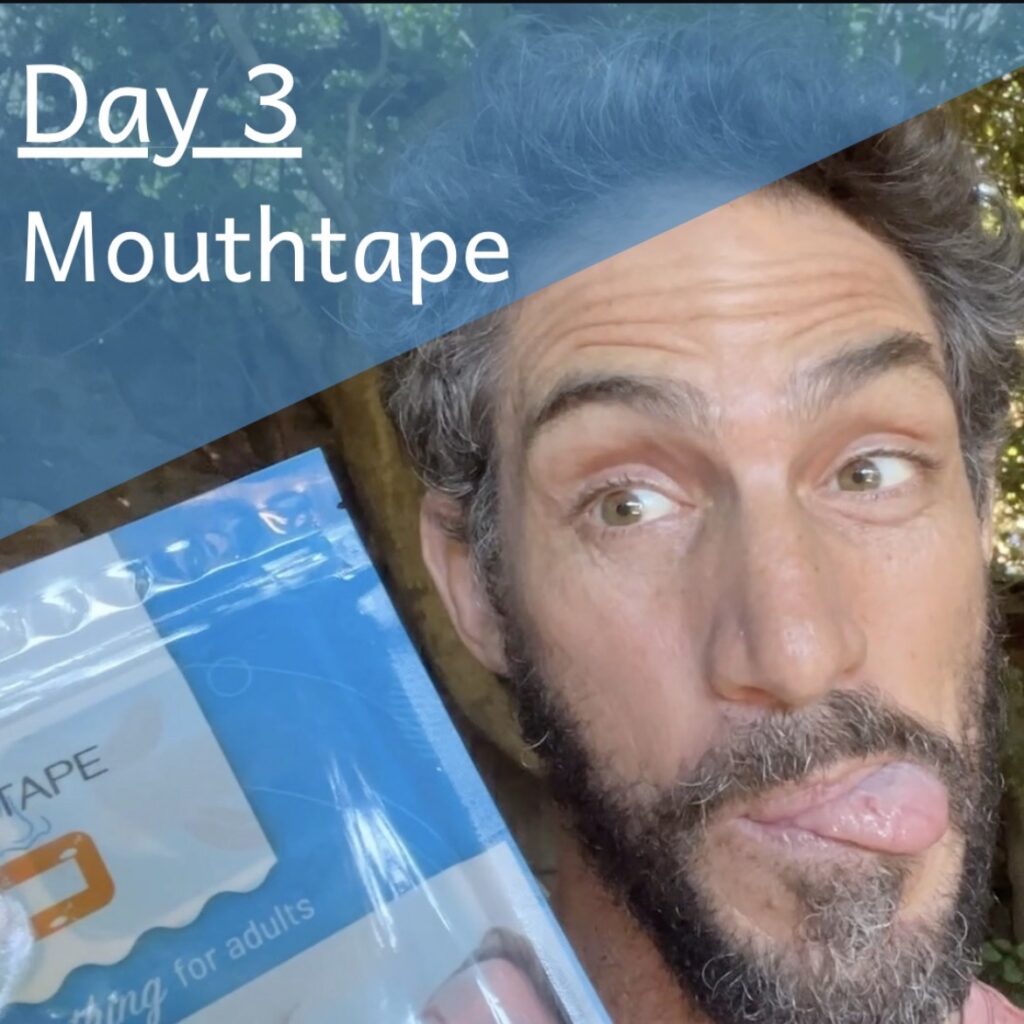
And it worked. My snoring dropped by somewhere around under an hour on the nights the tape stayed on. And on those nights, I felt it. I’d wake up with a clear head and a normal, non-dry mouth instead of the foggy, parched start to the day I’d taken for granted for years.
That was the moment it clicked for me, there was genuinely something in this. That first taste is what inspired the whole journey. It’s the reason that when the tape started to annoy me, I didn’t just shrug and quit; I kept looking for a better way to get the same result.
The tongue exercises are where that search led. That “on the nights it stayed on” is the problem. I’d get irritated with it in my sleep and pull it off. I’d find it in my hair. On the mattress. Stuck to my girlfriend, no joke. I also had to be clean-shaven for it to stick, which is its own inconvenience.
I tried it, saw results, drifted off it, went back to normal. I came back to it a couple of years later and the same thing happened. It treated the symptom, and only when I remembered to, and only when it cooperated. A word of caution on mouth taping. It’s not for everyone, and the research is genuinely mixed.
A 2025 systematic review found limited benefit and real risk, especially for anyone with a
blocked nose, in the worst cases it can make breathing during sleep worse rather than better.
If you have nasal congestion or obstruction, suspected or diagnosed sleep apnea, or acid reflux, don’t tape your mouth without talking to a doctor first. I did it without medical advice; I’m not recommending
you do the same. (Source: PLOS One systematic review, 2025)
The Real Fix: Tongue Exercises
When I dug deeper, I found what I’d been missing. A big driver of snoring is a weak tongue. During sleep the tongue relaxes and falls back into the throat, narrowing the airway, and that narrowing is what vibrates and makes the sound. Tape holds the mouth shut, but it does nothing about the tongue.
So I started training it.
This isn’t fringe. A meta-analysis of the research found that these exercises, known as myofunctional therapy, reduced snoring intensity by around 51% and cut the time people spent snoring by roughly a third. (Source: Camacho et al., European Archives of Oto-Rhino-Laryngology, 2018)
For me, this was the shift from treating the symptom to treating the cause. It’s also cheaper, less irritating, and I don’t have to be clean-shaven to go to sleep.
The exercises I do
I do these every morning as part of my yoga practice, three to five minutes, non-negotiable, and I’ll throw in a few extra reps through the day if I’m at my desk or waiting on something.
Here’s the full set, roughly in the order I built them up:
- Palate press. Push the tip of the tongue flat against the roof of the mouth (the
hard palate) and hold. This is the foundation, the position everything else
builds from. - Palate press with jaw movement. Keep the tongue pressed into the palate
while you slowly open and close the jaw. Adding that movement loads the
muscles harder and builds pressure through the jaw. - Hook and pull. Slide the tongue back, hook the tip against the back of the hard
palate, and try to draw it forward against its own resistance. This works the
length of the tongue, not just the tip. - Side presses. Push the tongue sideways against your thumb, then into the
inside of each cheek against a finger, left and right. You’re strengthening the
tongue against resistance in every direction. - Deep strengthening. The one that’s made the biggest difference lately: engage
the whole tongue downward toward its base and the muscles of the throat, so
you can actually feel it working deep down rather than just at the tip. Stretch and
strengthen the full length of it, as far down as it goes.
Start with the palate press and tongue posture, then layer the others in over a couple of
weeks as the muscle wakes up. A few things matter more than people expect: keep the
pressure firm but controlled, work the deep muscles and not just the tip, and don’t let it
turn into a jaw workout, if your jaw is doing all the effort, you’re missing the target.
Getting that technique and the week-to-week progression right is a lot of what I fine-tune
with people directly, because doing them slightly off is the main reason someone
concludes “it didn’t work.”
(A note on anatomy: the tongue’s muscles anchor at the jaw and the hyoid bone and
connect into the muscles of the throat, that’s what you’re strengthening to hold the
airway open, rather than anything in the oesophagus itself.)
Tongue posture is the single most important thing
If you take one thing from this, take this: correct tongue posture. Rest the tip of your
tongue on the hard palate, just behind your front teeth, during the day. It does two
things at once, it makes mouth breathing almost impossible, and it trains the tongue
to hold that position instead of collapsing backward at night. But the tongue has to be
strong enough to stay there, which is exactly what the exercises build.
Be patient.
I didn’t see results overnight, the research suggested it takes a few weeks,
and that matched my experience almost exactly. After about three weeks of daily
practice I saw a clear improvement, and it’s kept getting better since. Last night I
recorded nine minutes of snoring. From over three hours. I have the tracking to prove
it. It does fluctuate and I still have the odd snort here and there but as you’ll see there’s
so much we have to consider.
The Other Things That Affect Snoring
The exercises did the heavy lifting, but tracking my sleep every night taught me that
snoring isn’t just about your tongue. A few factors moved the needle every time:
- Sleeping position. This is the easiest change to make tonight. On my back I
snore far more, gravity pulls the tongue and soft tissue straight back into the
airway. Rolling onto my side, into something like a fetal position, consistently
brings it down. - Hydration. If I go to bed dehydrated, the back of my throat dries out and the
snoring climbs. Drinking enough water genuinely helps. - Eating late. Big meals close to bedtime consistently made mine worse.
- The room’s air. This one surprised me. I stayed at a friend’s place and my
snoring shot back over two and a half hours, I woke up tired with a dry mouth
and throat. It was the heaters drying out the air in the room. Change the
environment and the numbers change with it.
What Changed
The snoring is the headline, but it’s not really the point. The point is how I feel. Even on
a short night, I woke up today on five and a half hours, I’m ready to get up. No lying
there for another half hour trying to shake off the tiredness. I wake up clear-headed and
focused, and it’s made a real difference to how much I get done. I never built the coffee
habit, because I’ve never needed it to feel awake.
It’s been a genuinely rewarding journey, not just for the sleep, but for what it taught
me about awareness, about paying attention to my own body and finding simple ways to
help it work well. A healthy body, a clear mind. That’s the whole thing.
When to See a Doctor
One honest caveat. Snoring can be harmless, but heavy snoring is also the main
symptom of obstructive sleep apnea, which is a medical condition worth taking
seriously. If you snore loudly, gasp or stop breathing in your sleep, or feel exhausted
during the day no matter how long you’re in bed, see a doctor before you rely on tongue
exercises or tape. These tools help many people, but they’re not a substitute for proper
diagnosis when something more serious is going on.
Where to Start
Start with tongue posture. Right now, rest the tip of your tongue on the roof of your
mouth just behind your front teeth, and notice how often through the day it isn’t there.
Then add a few minutes of the exercises each morning and give it three weeks before
you judge it.
That’s it, it costs nothing and it treats the actual cause. If you want to go further with
your breathing, for sleep, stress, focus, or all three, this is exactly the kind of work I do
with people one-on-one, online and in person in Cape Town. The breath is the most
direct tool we have for changing how the body and mind function, and most of us
were never taught to use it.
Book your free introductory session